
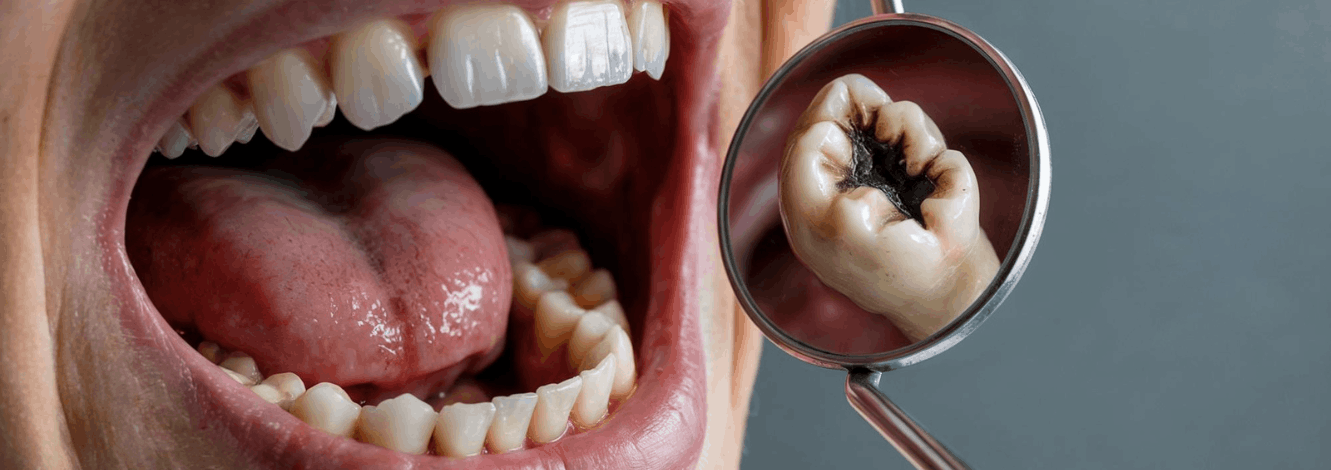
A small black spot on your tooth may not seem like a big problem at first. You may not feel any pain, so it is easy to ignore it. But what starts as a small cavity can slowly become deeper, reach the inside of the tooth and require root canal treatment.
When this happens, many people think, “The tooth is badly damaged, so it probably needs to be removed.” But that is not always the case. In many situations, a dentist can treat the infection and save the natural tooth with Root Canal Treatment. The treatment needed depends on how deep the cavity is and how much healthy tooth is left.
First, let’s understand what a cavity actually is and what happens when it gets deeper.
A cavity is a damaged area in a tooth caused by tooth decay. It usually develops when bacteria in the mouth feed on sugars and produce acids that slowly wear away the tooth.
At first, a cavity may not cause any pain. You may only notice a small spot or nothing at all. But if the cavity is not treated, it can continue to get deeper into the tooth. As much as cavity goes, the chance of pain, sensitivity, or infection increases.
A small cavity needs only a filling. But when decay gets closer to the pulp, the tooth can become more sensitive.
You may notice:
The bacteria can irritate or infect the pulp. Once the pulp becomes badly infected, simply placing a filling over the cavity may not solve the problem.
This is where Root Canal Treatment may help.
No. A deep cavity does not mean that the tooth needs to be removed. If the dentist finds that enough healthy tooth structure remains and the tooth can still be repaired, that means saving this tooth is possible.
The dentist will look at the condition of the tooth, its roots, and the surrounding area before recommending any treatment. In some cases, the options may include:
In the tooth, there is a small space containing nerves and blood vessels. When deep decay infects this area, the dentist needs to remove the infected tissue.
During the root canal treatment, the dentist:
The aim is to remove the infection while saving your natural tooth.
If a tooth can be safely repaired, keeping your natural tooth is always a better option than removing it.
Your natural tooth helps you chew normally and keeps the surrounding teeth in their usual positions. Removing it also leaves a space that may later need to be replaced with an implant, bridge, or another dental solution.
A cavity does not heal or go away on its own.
You may have little or no pain at first, but the decay can continue to spread. If it reaches the pulp, infection can develop. Over time, this may lead to:
This is why it is important to get early treatment on Deep Cavity and avoid more complicated dental problems later.
Yes. The seriousness of a dental problem does not always depend on how much pain there is.
Sometimes a tooth can have a deep infection without having continuous pain. In other cases, the pain may come and go, which can make you think the problem has gone away.
If you have a known deep cavity, repeated sensitivity, or a tooth that has changed colour, it is better to have it checked instead of waiting for severe pain.
A dentist does not decide this just by looking at the cavity. They may check:
The dentist may also take an X-ray to understand what is happening below the visible part of the tooth. After the examination, the dentist can explain whether the tooth can be saved with root canal treatment or what other treatment would be suitable.
The tooth may feel slightly sensitive or uncomfortable for a short time after treatment, especially if there was already an infection around it. Your dentist will guide you on eating, cleaning the tooth, and any other care you may need.
If a large part of the tooth has been damaged by decay, the dentist may recommend a crown. A crown covers and protects the remaining tooth and helps restore its function.
Regular brushing, flossing, and dental check-ups are important after dental treatment. A tooth that has received treatment can still develop decay if you do not care for it properly.
If you have a cavity that causes minor pain, then don’t wait for it to become severe pain. Schedule a dental check-up if you notice the following:
Early treatment can give you more options for protecting the tooth. Visit the best root canal clinic in Bandra and explore a better dental solution for your infected teeth.
A cavity may look small on the outside but can sometimes become much deeper inside the tooth. Once decay reaches the nerve, treatment becomes more important.
The good news is that a deep cavity does not always mean tooth extraction. If the tooth is still strong enough to repair, Root Canal Treatment can remove the infection and help you keep your natural tooth.
The best way to know what your tooth needs is to get it examined by a dentist. Early attention can make treatment simpler and may give you a better chance of saving the tooth.
At 1 Stop Dental Clinic, patients can discuss their dental concerns and understand the treatment options suitable for their teeth. If you are looking for the Best Root Canal Treatment in Bandra, a proper dental examination is the right place to start.
Explore how root canal treatment can help save a deeply decayed tooth by treating the infection, preserving the natural tooth structure, and restoring comfortable function with the right dental care.
We understand just how closely connected oral health is to your overall health, confidence, and appearance, and we pride ourselves on cultivating a friendly, upbeat dental environment where you can always feel comfortable in our care.
2nd floor, 203/204/302, Kanaiya, 250, Linking Rd, opp. National College, Bandra West, Mumbai, Maharashtra 400050