
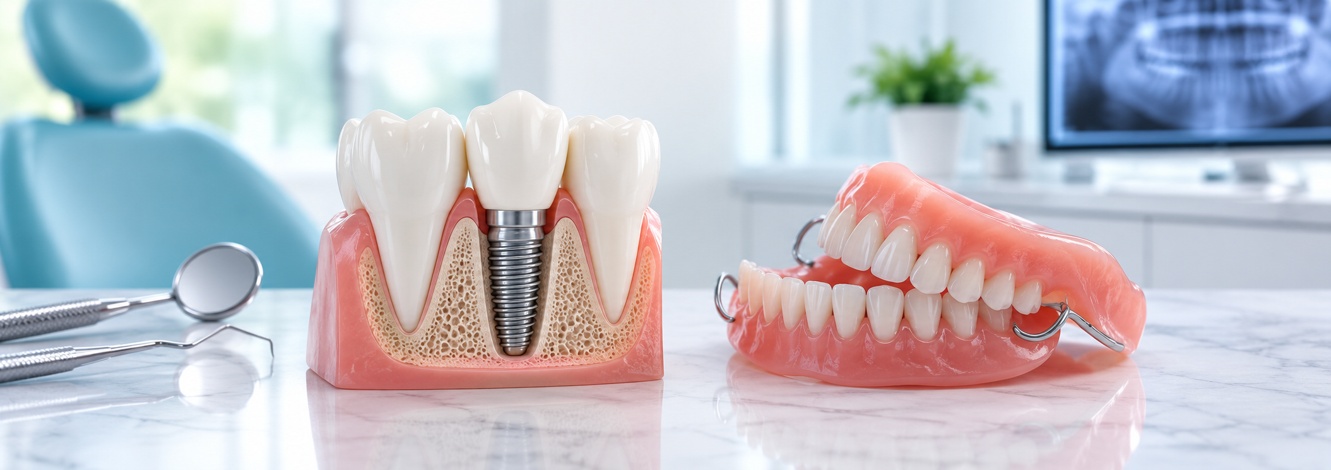
Losing a tooth changes more than your appearance, it affects how you chew, speak, and feel day to day. If you are weighing your options, chances are you have come across two main choices: dental implants and removable dentures.
This blog breaks down dental implants compared to removable tooth replacements so you can decide what is right for your smile.
A dental implant is a titanium fixture that a dentist places into the jawbone to serve as a root for a missing tooth. As the surrounding bone heals and fuses around it, a process called osseointegration, a custom crown is attached on top to restore the visible tooth.
The result is a replacement that looks and functions much like a natural tooth.
Removable teeth, commonly known as dentures, are prosthetic replacements that rest on the gum surface. They come in two forms, partial dentures for one or a few missing teeth, and full dentures for an entire arch.
Many patients find them inconvenient over time, they require removal for cleaning, rely on adhesives, and offer reduced chewing efficiency.
Here is how these two solutions differ across the factors that matter most.
Removable dentures use suction or adhesive to stay in place, so they can shift a bit while eating or talking. Many wearers find that annoying.
Implants are fixed directly into the jawbone. Once placed, they stay put. You can eat, laugh, and speak without giving your teeth a second thought.
After a tooth is lost, the jawbone in that area begins to lose density over time because it is no longer receiving stimulation from a root. This gradual shrinkage can alter the shape of the face, causing the cheeks to appear hollow and the jaw to look narrower.
Removable dentures rest on the gum surface and offer no stimulation to the bone beneath. Implants, by contrast, function like natural roots, they transmit pressure into the bone during chewing, which keeps it active and healthy.
One of the most significant benefits of dental implants is this ability to preserve the jawbone, something no removable alternative can offer. When patients discover this, it often becomes one of the deciding benefits of dental implants for their situation.
Many people with removable teeth quietly give up on certain foods, hard fruits, chewy proteins, crunchy vegetables, because the denture cannot handle the force required. This can gradually limit nutrition and overall quality of life.
With implants, biting force is restored close to natural levels. Patients can return to eating without restrictions, which is one of the most appreciated benefits of dental implants reported after treatment.
Removable teeth must be taken out each night, soaked, and brushed separately. If this routine slips, bacteria can accumulate underneath the denture and irritate the gums.
Implants are cleaned the same way as natural teeth, regular brushing and flossing is all that is needed. There are no soaking tablets, no adhesive pastes, and no separate cleaning steps. When comparing dental implants compared to removable tooth options on hygiene alone, the difference in daily convenience is significant.
Removable dentures typically need adjustment or full replacement every five to ten years as the jaw and gum shape continue to change. This means repeated costs and clinic visits over time.
With proper oral hygiene and routine dental check-ups, Dental Implants can last for many years, often well beyond a decade.
The benefits go beyond how your smile looks, they extend to how your jaw functions, how you eat, and how you feel day to day.
Yes. Titanium implants have been used in dentistry for decades with a strong safety record. The material is biocompatible, the body accepts it and bone tissue bonds to it naturally over time.
Candidacy still depends on individual health factors. Bone density, gum condition, and medical history all play a role, so a proper evaluation with a qualified dentist is essential before proceeding.
Most healthy adults who have lost one or more teeth can explore this option. You are likely a good candidate if:
A detailed assessment, including X-rays or a 3D scan, will help your dentist confirm the right course of action.
For patients who are eligible, dental implants offer something that removable teeth simply cannot, a stable, long-term solution that works for our body rather than sitting on top of it.
At 1 Stop Dental Clinic in Bandra, Mumbai, each patient receives a personalised treatment plan designed around their oral health needs and long-term goals. Whether you are exploring this option for the first time or reconsidering an existing denture solution, consulting a trusted dental clinic in Bandra is the best starting point for making an informed choice.
Discover why dental implants offer a more stable, natural-looking, and long-lasting solution compared to removable teeth, helping you eat, speak, and smile with greater confidence.
We understand just how closely connected oral health is to your overall health, confidence, and appearance, and we pride ourselves on cultivating a friendly, upbeat dental environment where you can always feel comfortable in our care.
2nd floor, 203/204/302, Kanaiya, 250, Linking Rd, opp. National College, Bandra West, Mumbai, Maharashtra 400050